Design Systems for Safety

01 THE AUDIT BASELINE: BURYING VALID PROTOCOLS IN PAPERWORK
A comprehensive workplace safety audit was executed across the campus laboratories and workshops. This exhaustive technical assessment generated a robust compliance report outlining critical corrective actions. However, these vital safety protocols remained entirely trapped inside a static 35,000 word document. While the audit's findings and technical data were completely accurate, the institution lacked any ground-level execution on the floor. This administrative gap left complex physical environments exposed to heavy liability, creating a severe disconnect between high-level regulatory compliance and daily student operations.
A comprehensive workplace safety audit was executed across the campus laboratories and workshops. This exhaustive technical assessment generated a robust compliance report outlining critical corrective actions. However, these vital safety protocols remained entirely trapped inside a static 35,000 word document. While the audit's findings and technical data were completely accurate, the institution lacked any ground-level execution on the floor. This administrative gap left complex physical environments exposed to heavy liability, creating a severe disconnect between high-level regulatory compliance and daily student operations.
02 THE INSTITUTIONAL FRICTION: MANUAL DEPENDENCIES AND TALENT RISK
Leaving valid safety data confined to paper files creates heavy operational friction for an engineering institute. Without real-time floor visibility, lab safety relies entirely on manual enforcement by professors and technicians. This unsustainable approach creates structural dependencies, increases human error, and leaves the institution exposed to severe reputational damage. In a highly competitive academic market, chaotic or unstandardized lab environments directly threaten institutional legacy equity. Furthermore, a failure to modernize physical operations actively chokes the institute’s ability to attract top-tier research faculty and secure elite student talent pipelines.
Leaving valid safety data confined to paper files creates heavy operational friction for an engineering institute. Without real-time floor visibility, lab safety relies entirely on manual enforcement by professors and technicians. This unsustainable approach creates structural dependencies, increases human error, and leaves the institution exposed to severe reputational damage. In a highly competitive academic market, chaotic or unstandardized lab environments directly threaten institutional legacy equity. Furthermore, a failure to modernize physical operations actively chokes the institute’s ability to attract top-tier research faculty and secure elite student talent pipelines.
03 BRAND ARCHITECTURE: MATRIX INFRASTRUCTURE
A sophisticated campus design system was engineered to translate the valid audit report into a functional visual landscape. The core findings were synthesized into a modular series of 50 high-impact structural posters. This comprehensive architecture categorizes complex multi-departmental hazards into distinct visual tracks: mechanical, electrical, chemical, and medical zones. By utilizing highly standardized informatory, cautionary, and mandatory design frameworks, we wrapped dense technical rules into a clean, intuitive visual language. This systemic approach bridges communication gaps and instantly standardizes student behavior across all engineering facilities.
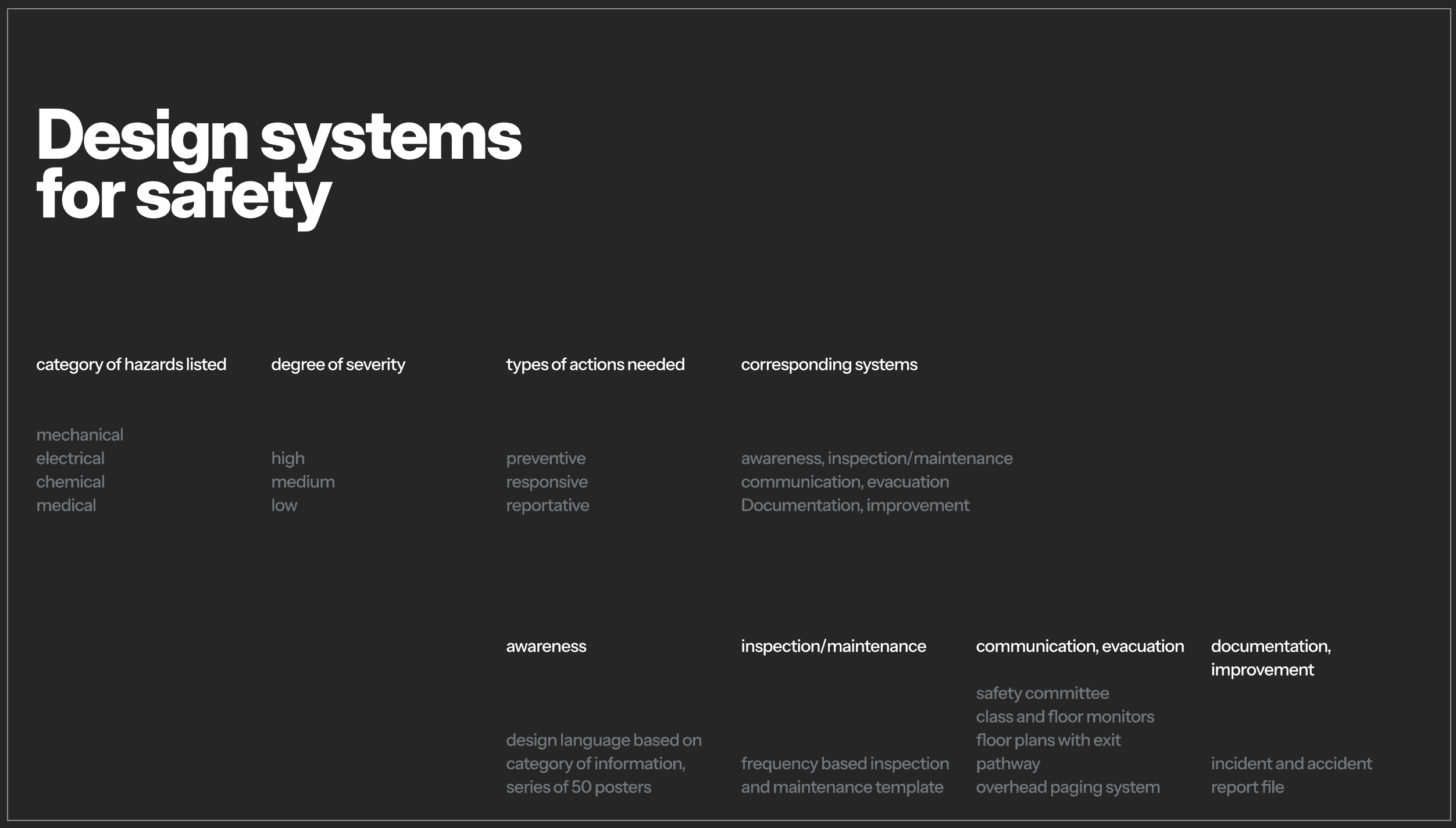
A sophisticated campus design system was engineered to translate the valid audit report into a functional visual landscape. The core findings were synthesized into a modular series of 50 high-impact structural posters. This comprehensive architecture categorizes complex multi-departmental hazards into distinct visual tracks: mechanical, electrical, chemical, and medical zones. By utilizing highly standardized informatory, cautionary, and mandatory design frameworks, we wrapped dense technical rules into a clean, intuitive visual language. This systemic approach bridges communication gaps and instantly standardizes student behavior across all engineering facilities.
04 SYSTEMIC LAB INTEGRATION: VISUALIZING CORRECTIVE ACTIONS ON THE FLOOR
The design system systematically embeds active safety compliance directly into daily lab and workshop workflows. High-contrast spatial layouts explicitly define mandatory exit pathways to guarantee rapid building evacuations. Frequency-based inspection templates are mounted directly onto complex machinery faces to completely eliminate human oversight errors. Specialized color-coded nodes provide instant visual anchoring for eyewash stations and emergency equipment. Finally, standardized physical reporting are integrated into the institutional workflow to secure unalterable incident documentation and continuous process improvement loops.
The risks categorized were developed into a series of 50 posters communicating the severity and compliance required. In addition, standardized inspection, maintenance and reporting documents were incorporated into the organizational workflow. And an awareness campaign in collaboration with the local fire department was conducted for the first time in the history of the organization.
The design system systematically embeds active safety compliance directly into daily lab and workshop workflows. High-contrast spatial layouts explicitly define mandatory exit pathways to guarantee rapid building evacuations. Frequency-based inspection templates are mounted directly onto complex machinery faces to completely eliminate human oversight errors. Specialized color-coded nodes provide instant visual anchoring for eyewash stations and emergency equipment. Finally, standardized physical reporting are integrated into the institutional workflow to secure unalterable incident documentation and continuous process improvement loops.
The risks categorized were developed into a series of 50 posters communicating the severity and compliance required. In addition, standardized inspection, maintenance and reporting documents were incorporated into the organizational workflow. And an awareness campaign in collaboration with the local fire department was conducted for the first time in the history of the organization.
05 INSTITUTIONAL OUTCOMES: OPERATIONAL STANDARDIZATION AND LEGACY PROTECTION
Making the audit findings hyper-visible protects the institute’s long-term legacy equity and shields the organization from liability. The polished, world-class workspace builds a powerful native pipeline for elite student recruitment. It serves as a visual proof point of operational excellence that consistently attracts top-tier research faculty and corporate partners. Ultimately, this system replaces fragmented administrative paperwork with a repeatable, self-sustaining operational framework that redefines campus safety standards.
Making the audit findings hyper-visible protects the institute’s long-term legacy equity and shields the organization from liability. The polished, world-class workspace builds a powerful native pipeline for elite student recruitment. It serves as a visual proof point of operational excellence that consistently attracts top-tier research faculty and corporate partners. Ultimately, this system replaces fragmented administrative paperwork with a repeatable, self-sustaining operational framework that redefines campus safety standards.
Ready for your diagnostic?
© 2026 ADezen. All rights reserved.
Inquiries
hello@adezen.co
ADezen LLP
LLPIN ACT 6319
Regd. Office: 12/35 Rams Nagar, P.N.Pudur Post Office, Coimbatore, Tamil Nadu,
India 641 041
+91 98 446 39 335
ADezen
© 2026 ADezen. All rights reserved.
Inquiries
hello@adezen.co
ADezen LLP
LLPIN ACT 6319
Regd. Office: 12/35 Rams Nagar, P.N.Pudur Post Office, Coimbatore, Tamil Nadu,
India 641 041
+91 98 446 39 335
ADezen
© 2026 ADezen. All rights reserved.
Inquiries
hello@adezen.co
ADezen LLP
LLPIN ACT 6319
Regd. Office: 12/35 Rams Nagar, P.N.Pudur Post Office, Coimbatore, Tamil Nadu,
India 641 041
+91 98 446 39 335